
What this covers
-
What a Mat Is Actually For
-
Concrete Is the Hardest Case
-
Wood Floors Already Have Some Give
-
Tile and Stone Follow the Slab
-
Carpet Is Where the Logic Reverses
-
An Area Rug Is Not Carpet
-
Vinyl Plank and Laminate Sit in Between
-
What Barefoot Changes
-
A Floor-By-Floor Summary
-
The Thirty-Second Test
-
The Point Underneath All of This
Advice about standing mats is almost entirely about the mat. Thickness, density, material, edge bevel, surface texture. All of it useful, and all of it written as though every mat lands on the same floor.
It does not. Mat thickness is published and floor deflection is not, so half the system gets specified to a tenth of an inch and the other half is whatever the building happened to come with. The same mat on a basement slab and on a first-floor wood deck is doing two different jobs.
What a Mat Is Actually For
A standing mat compresses under load to encourage small shifts in posture. That is the mechanism, and it is worth stating plainly because it is often described as cushioning, which suggests softness is the goal.
It is not. Standing perfectly still is the thing that causes trouble, not standing as such. A surface with a little give makes the body make continuous micro-adjustments to stay balanced, and those adjustments keep the calf muscles working rather than locked. A mat that is simply soft removes the feedback and produces a different kind of fatigue.
So the question for any given floor is narrow: how much give is already there, and how much does the mat need to add.
Concrete Is the Hardest Case
Concrete does not deflect under a person’s weight. A slab is effectively infinitely stiff at the scale of one person standing on it, which means every bit of give in the system has to come from the mat, the shoe, or the body.
This is why the phrase “standing on concrete all day” appears so often in searches for mats. It is the floor that produces the clearest complaint, and it is common in basements, garages, converted industrial spaces and most ground floors in slab-built houses.
On concrete the mat is carrying the whole job. Thinner mats underperform noticeably here in a way they do not elsewhere.
Wood Floors Already Have Some Give
A wood floor laid over joists deflects slightly under load. Upper floors in timber-framed houses flex a small amount, which is the same reason a heavy footstep is audible downstairs. That deflection is small, but it is not nothing, and it is give the mat does not have to supply.
The practical consequence is that a mat that feels adequate on a first-floor wood deck can feel thin when the same person tries it in a basement. Nothing changed about the mat.
Engineered wood over a slab is a different case and behaves much closer to concrete, because the give was never in the wood. It was in the joists.
Tile and Stone Follow the Slab
Tile laid on a concrete slab behaves like concrete underfoot. The tile is thin and rigid and it transmits whatever is beneath it. Tile over a wood subfloor keeps a little of the subfloor’s give.
Tile adds one thing concrete does not: it is cold, and it is slippery under a sock. Both matter for anybody standing at a desk for hours, and both point toward a mat with a textured top surface rather than a smooth one.
Carpet Is Where the Logic Reverses
This is the case that gets the standard advice wrong, and it is the most common floor in a bedroom or a spare room home office.
Carpet already provides compression beneath a standing mat. Carpet plus underlay is a compressible layer, sometimes a substantial one, and adding a thick mat on top stacks two soft layers.
Compression stacked on compression reduces lateral stability. The body reads an unstable surface and responds by bracing, which recruits the same muscles the mat was supposed to relieve. People describe the result as the mat “not working”, or as feeling unsteady, and both descriptions are accurate.
On carpet the correct move is usually the opposite of the instinct:
-
A thinner, denser mat rather than a thicker, softer one
-
A firm mat that provides a defined, stable surface rather than more cushioning
-
In some cases no mat at all, if the carpet and underlay are thick
That last option is worth taking seriously. A plush carpet over a good underlay may already be supplying what a mat would add.
An Area Rug Is Not Carpet
An area rug adds a thin compressible layer over a hard floor, and it introduces a problem fitted carpet does not have: it moves.
A mat placed on a rug can shift laterally during weight transfer. Every time weight moves from one foot to the other there is a small sideways force, and a mat on a rug on a hard floor has two interfaces that can slide rather than one. Over a long session this produces a mat that has crept several inches from where it started, and occasionally a genuine slip.
If a rug is in the working position, the mat should sit on the hard floor beside it rather than on top of it, or the rug should be anchored with a proper non-slip underlay.
Vinyl Plank and Laminate Sit in Between
Luxury vinyl plank and laminate over a slab are close to the concrete case. Over a wood subfloor with a foam underlayment they gain a small amount of give.
Both have a second characteristic that matters more than the deflection. They are smooth and they can be slick, especially in socks, so the mat’s grip on the underside is doing real work. A mat with a smooth backing on a smooth floor will travel.
What Barefoot Changes
Bare feet sense surface texture that shoes conceal. A shoe is already a layer of compression and a layer of insulation, and it flattens the differences between floors considerably.
Anybody working barefoot or in socks, which describes most people working from home, is getting the floor and the mat directly. Three things become more important:
-
Surface texture, because it is felt rather than filtered
-
Temperature, because a cold slab or cold tile conducts heat away from the feet continuously
-
Edge profile, because a bare toe finds an unbeveled edge repeatedly
This is also why mat recommendations written for commercial kitchens and warehouse floors translate imperfectly to a home office. Those are written for people in work boots.
A Floor-By-Floor Summary
|
Floor |
Give already present |
What the mat has to supply |
Common mistake |
|
Concrete slab |
None |
All of it; prioritize thickness and density |
Choosing a thin mat |
|
Tile on slab |
None |
All of it, plus warmth and grip |
Ignoring the cold |
|
Wood over joists |
Slight |
Most of it |
Assuming it matches a basement |
|
Engineered wood on slab |
Minimal |
Nearly all of it |
Assuming wood means give |
|
Vinyl plank or laminate |
Slight to none |
Most of it, plus a grippy underside |
A smooth-backed mat that slides |
|
Fitted carpet with underlay |
Substantial |
Stability more than cushioning |
Buying the thickest mat available |
|
Area rug on hard floor |
Thin and unstable |
Stability; better to sit beside the rug |
Stacking mat on rug |
The Thirty-Second Test
There is no need to know what is under the floor. Stand where the desk is, in whatever you normally wear on your feet, and stay still for two minutes.
Where the discomfort turns up tells you what to buy.
|
What you feel first |
What it indicates |
What to look for |
|
Heels and arches aching |
A hard floor with no deflection |
Thicker and denser |
|
Calves working the whole time |
The surface is already soft |
Firmer and thinner |
|
A vague sense of swaying |
Two compressible layers stacked |
Firmer, or no mat at all |
|
Cold feet before anything else |
The floor is conducting heat away |
Material and thickness together |
|
The mat has moved by the end |
A slick floor or a rug underneath |
A grippier backing, or move off the rug |
Run it twice if the floor is uncertain, once in shoes and once barefoot. The two answers can differ, and the barefoot answer is the one that matters if that is how the desk gets used.
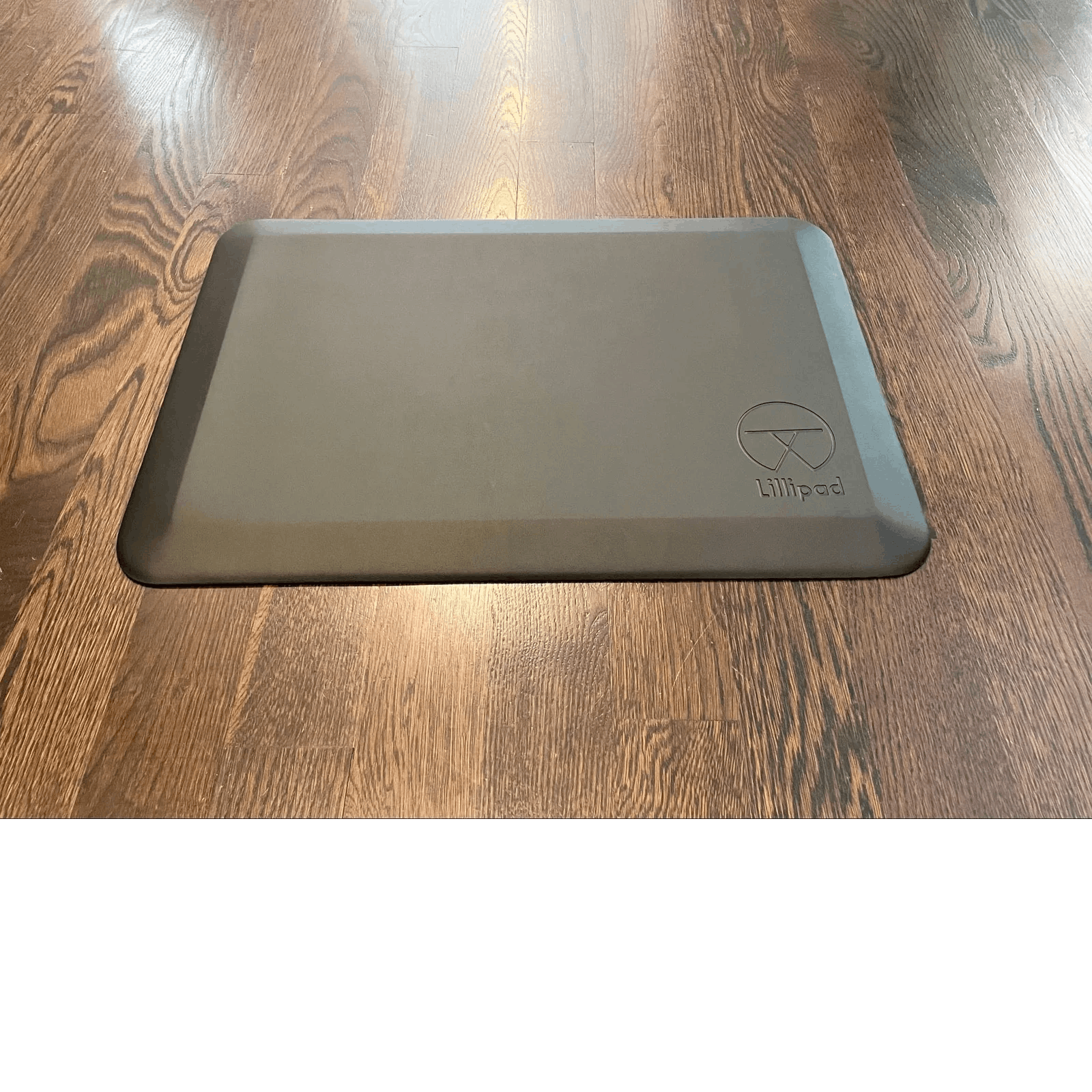
Size deserves a moment too. A mat only helps across the area it covers, and a small mat encourages standing in one position, which is the thing the mat exists to prevent. Enough width to shift weight sideways is more useful than extra thickness, which is why anti-fatigue standing mats sized to sit inside a desk’s own leg frame tend to get used properly rather than pushed out of position.
The Point Underneath All of This
The mat and the floor are one system. Specifying one of them carefully and inheriting the other is how people end up owning a good mat that does not help.
Thirty seconds of standing still in the actual spot answers the question better than any specification comparison, because it measures the only thing that matters, which is what that floor does to those feet.
It also explains why the same mat collects glowing reviews and dismissive ones in equal measure. Both sets of reviewers are describing their floor, accurately, and neither of them mentions it.