
Key Takeaways
- Compare a foldable medical scooter to a power chair based on one real test: can the rider transfer safely, steer with confidence, and manage short periods of seated travel without extra support?
- Check the lifting math before buying any medical scooter—total weight, folded size, battery removal, and trunk height will decide whether the scooter gets used or stays at home.
- Match the mobility scooter to the trip, not the ad: airports, cruises, RV storage, hotel carpet, parking lots, and museum days each put different demands on turning space, wheel size, and battery range.
- Review coverage and pricing with a clear eye, because a doctor can prescribe a medical scooter, Medicare may help in limited cases, and “free” offers often leave out service, parts, or travel-ready features.
- Set limits on where a lightweight folding scooter should go; it may handle pavement, ramps, and indoor floors well, but heavy duty terrain, long outdoor runs, and rough surfaces call for a different mobility device.
- Use a side-by-side checklist for any portable scooter: weight capacity, seat comfort, speed settings, braking, anti-tip design, return policy, replacement batteries, and travel approval details.
More adults ages 65 to 85 are refusing to plan their lives around fatigue, long terminals, or the question nobody likes asking: “Will I make it from the parking lot?” That’s a big reason the foldable medical scooter has moved from occasional backup device to regular travel companion. In practice, the shift is easy to see—people who once rented bulky mobility equipment for cruises or airports now want something they can store in an RV bay, lift into a trunk, and use without turning every outing into a family project.
And expectations have changed fast. A scooter can’t just move; it has to fold, fit, — feel manageable on a real Tuesday, not just in a showroom (that part gets missed all the time). For part-time users, a lighter portable model often makes more sense than a heavy duty unit that’s harder to load, harder to store, and harder to justify for occasional use. The honest answer is simple: if a mobility device is too awkward to bring along, it won’t get used—and that defeats the whole point.
Why the foldable medical scooter is showing up in more travel and daily living plans
More adults between 65 and 85 are buying a foldable medical scooter for one plain reason: it fits real life better than the old, bulky models that were built more for full-time use than occasional trips. In practice, airports, cruises, RV storage bays, hotel rooms, museums, and long parking lots have pushed buyers toward lighter, folding mobility equipment that can be loaded without turning every outing into a lifting event.
At the same time, the market for scooters for disabled adults has shifted from strictly medical need to lifestyle need. That matters. A person may still walk through the kitchen, move around the house, and manage short errands, yet need seated help for a 2,000-step terminal or a full day at a park. That part-time pattern is where a portable electric scooter keeps gaining ground.
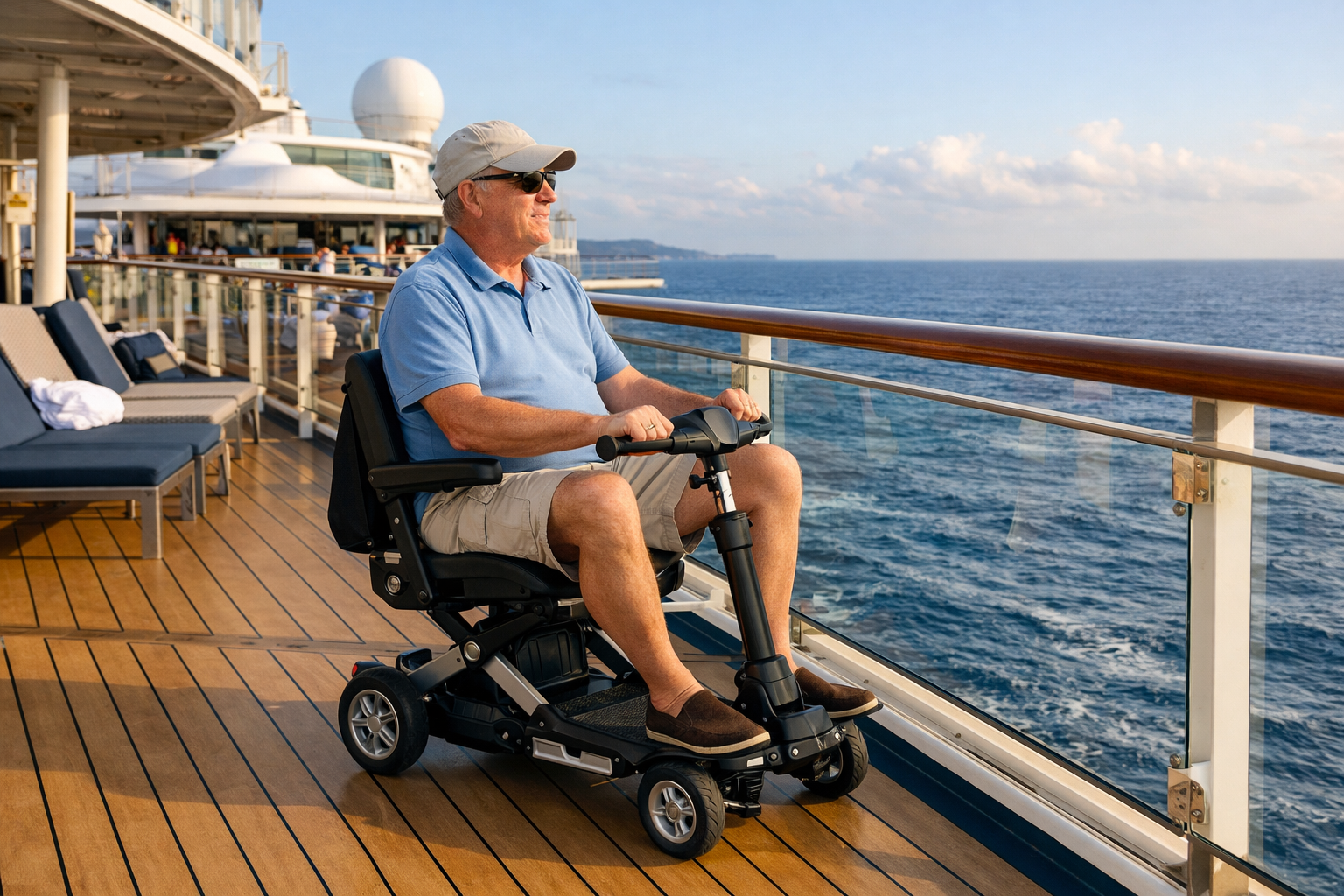
How aging adults are using a portable scooter for airports, cruises, RV trips, and long outings
Travel use is driving a lot of this demand.
A foldable scooter can work for gate areas, cruise boarding lines, shore excursions, convention centers, and sightseeing days where fatigue shows up after hour two—not minute ten. For retirees who split time between home and travel, a folding model also stores more easily in a trunk, closet, or RV compartment than a heavy duty unit with a larger frame and battery pack.
And expectations have changed. Buyers now ask if a device is airline approved, whether the battery is removable, how much the heaviest piece weighs, and if a spouse can lift it after lunch on day six of a trip. Those are smart questions. They cut past sales language and get to the issue that decides whether the scooter gets used or stays home.
Why a lightweight folding scooter feels more practical than a heavy duty mobility device for part-time use
Plainly put, weight changes everything. A travel scooter in the 35- to 60-pound class can still be a lot to manage, but it’s far more realistic than a 100-pound machine that needs a lift. For adults who only need help for distance walking, a lightweight or portable model often feels less medical, less heavy, and less dependent on family help.
Here’s what that actually means in practice.
Some shoppers also compare a wheelchair and scooter side by side before deciding. That’s wise, because a scooter suits users who can sit upright, hold tiller controls, and transfer safely on and off, while a wheelchair may fit better if trunk support or simpler transfers are the bigger issue.
What a medical scooter needs to do well before anyone should buy one
Specs matter. But not all specs matter equally.
Weight, folded size, and lifting reality: what adults 65 to 85 can actually manage
The honest answer is that listed product weight can mislead people. A brochure may say 58 pounds, yet the question should be: how heavy is the heaviest lift piece after the battery comes out? If the frame still weighs 42 pounds, that may be too much for a 74-year-old spouse with arthritis. A good buying target for travel is often a folded size that fits a standard car trunk and a heaviest piece the household can lift twice in one day—out and back in.
For adults 65 to 85, these checkpoints help:
- Heaviest piece: under 40 pounds is easier for part-time travel use
- Folded footprint: small enough for trunk storage or RV compartments
- Handle points: real grab points, not awkward frame edges
- Seat removal: quick and simple, not a puzzle
Battery range, motorized performance, and indoor turning space that matter in real life
Range claims need a little skepticism. A company may list 10 to 15 miles, but real use on hotel carpet, ramps, cruise decks, and parking lots usually cuts that down. For most part-time users, 6 to 10 practical miles is enough for a full outing. That covers airport movement, museum days, and large medical campuses with some battery left in reserve.
The short version: it matters a lot.
So what does that mean in practice? The buyer should look at battery chemistry, charging time, and whether the pack is approved for air travel. A small motorized travel scooter with a tight turning radius can feel much better indoors than a larger model with more range — poor maneuvering in elevators and dining areas. A portable unit that turns well in a hotel hallway often wins over one that looks stronger on paper.
Wheel size, seated comfort, and terrain limits on pavement, hotel carpet, ramps, and parking lots
Wheel size tells buyers a lot. Smaller wheel designs do well on smooth floors and pavement, but thick carpet, cracked sidewalks, and rough parking lots can expose their limits fast. That doesn’t make them bad choices. It just means a foldable scooter is usually meant for ordinary travel surfaces, not rough terrain, loose gravel, or long road shoulders.
Comfort deserves equal attention—especially for seniors using the seat for three to six hours at a stretch. Check seat width, seat padding, tiller reach, and foot placement. A seated rider who feels cramped after 20 minutes won’t feel better after a terminal delay. Stable braking, anti-tip design, and adjustable speed settings also matter more than glossy extras (cup holders are nice, but they’re not safety features).
Medical scooter vs power chair: which mobility choice fits the user, the caregiver, and the trip
Not every mobility problem calls for the same tool. And that’s where expensive mistakes happen.
When a folding electric scooter works better for adults who can still transfer on and off safely
A folding electric scooter usually works best for adults who still stand briefly, pivot, and sit without full hands-on help. If the user can get in and out safely, maintain posture, and steer with both hands or one steady hand, a scooter offers a practical mix of range, portability, and comfort for errands and travel. That’s why a simple scooter keeps showing up in vacation planning, not just in doctor visits.
There’s also a caregiver benefit. A foldable model reduces loading strain, storage strain, and the awkward dance of fitting equipment into a small trunk. For couples traveling together, that can be the difference between going out twice a day and staying in after dinner.
When a power chair makes more sense than a portable mobility scooter
Here’s what most people miss: steering style and body support can outweigh portability. A power chair often makes more sense for users with weaker leg strength, less stable balance, reduced shoulder motion, or a need for tighter indoor control. People comparing a power wheelchair and scooter should focus on transfers, posture support, joystick skill, and daily use setting before they focus on price.
That gap matters more than most realize.
If the user struggles to remain upright without support—or can’t safely get on and off a scooter seat—a power chair is usually the safer answer. It may be heavier. It may take more planning. But safety wins.
Why a knee scooter, transport chair, or manual wheelchair may still be the better fit
A medical scooter isn’t the answer for every body or every trip. A knee scooter can fit short-term lower-leg recovery. A transport chair can make more sense for cruise excursions when a companion is always present. A manual wheelchair may still be the better choice for people who need simpler transfers, a lighter lift, or easier storage in very small spaces.
For some households, the smartest setup is a mix: one travel scooter for long days out and one manual backup for appointments. In more advanced care settings, a patient lift for medical mobility users may matter more than any seating choice, because safe transfers come before everything else.
How to buy a medical scooter without making an expensive mistake
Price matters, yes—but fit matters more.
What a foldable medical scooter usually costs, from cheap entry models to premium portable options
Most foldable and portable options land in a wide price band. Entry units can start around $900 to $1,500. Mid-range travel models often run $1,600 to $2,500. Premium portable designs with lighter frames, lithium batteries, and cleaner folding systems often push past $2,500. Cheap models can look appealing at first glance, yet battery quality, seat comfort, and service support often separate a short-term bargain from a long-term headache.
A buyer looking at medical scooters for adults should compare five items in one chart: total weight, heaviest piece, range, weight capacity, and folded dimensions. That one-page comparison saves people from buying based on color, ad copy, or one flashy claim.
Most people skip this part. They shouldn’t.
What Medicare may cover, what a doctor can prescribe, and why “free” scooter offers need a careful look
Can a doctor prescribe a scooter? Yes. Can Medicare pay for one? Sometimes, if the scooter is considered medically necessary for use in the home and the paperwork supports that need. But that standard often surprises families who want a scooter mostly for travel, shopping, cruises, or long outings. Those uses may be very real, yet home-use coverage rules are narrower than people expect.
That’s why “free scooter” offers deserve a pause. Often, the product tied to insurance approval isn’t the compact folding type people had in mind. And if a user wants ultra portable travel equipment, the out-of-pocket option may still be the better fit—less frustrating, faster to get, and more likely to match actual daily use.
Whether to buy new, used, or rental equipment for short-term recovery or vacation travel
New units suit people who expect repeated use over a year or more. Used equipment can save money, but battery age, charger condition, and missing parts are common problems. Rental works for a one-week cruise or a post-surgery month, though repeated rentals add up fast. A retired couple taking three trips a year can reach purchase cost sooner than they think—sometimes within 12 to 18 months.
Before purchase, check these points:
- Return policy: restocking fees, deadlines, and battery rules
- Service access: who handles repairs and parts
- Replacement batteries: price and shipping availability
- Travel approval: battery details for airline questions
- Weight capacity: leave a margin, don’t buy right at the limit
One industry retailer, 1800wheelchair, has noted the same trend seen across the market: older adults want portable mobility that fits travel, not just home use. That shift explains why foldable scooter demand keeps rising.
Which foldable medical scooter features matter most for adults 65 to 85 right now
Best fit by use case: airport travel, cruise boarding, museum days, RV storage, and everyday errands
Use case should drive the shortlist. Airport travelers need removable batteries, fast folding, and compact dimensions. Cruise passengers need easy boarding, deck maneuvering, and cabin storage that won’t eat the room. RV owners care about folded height and storage bay access. For museum days and errands, comfort and turning ability tend to matter more than top speed.
But here’s the thing.
The best model for a terminal isn’t always the best one for a full grocery run.
Think about what that means for your situation.
Lightweight scooter features that reduce caregiver strain without giving up comfort
The strongest travel designs reduce caregiver strain in small ways that add up: lighter battery packs, simpler folding latches, better carry handles, and seats that come off without wrestling the frame. A good setup feels boring to use—which is a compliment. If loading takes under two minutes and doesn’t strain wrists or backs, the equipment is doing its job.
Comfort still has to stay in the picture. Look for padded armrests, enough leg room, modest suspension if available, and a stable seated position during turns. Seniors don’t need a flashy machine. They need one that feels secure at hour three.
Heavy duty needs, higher weight capacity, and the point where foldable stops being the right answer
Sometimes foldable simply isn’t the right answer. Users needing a higher weight capacity, wider seats, stronger outdoor performance, or all-day use on mixed terrain may outgrow portable travel designs quickly. At that point, a heavy duty scooter or power chair becomes the better call, even if transport gets harder.
A practical shortlist should compare: heaviest lift piece, folded size, battery type, turning radius, seat comfort, wheel size, braking feel, and return terms. Ask one blunt question before buying: who will lift it, where will it ride, and how often will it actually be used? If the answer is fuzzy, keep shopping.
Not complicated — just easy to overlook.
Frequently Asked Questions
How to get a medical scooter for free?
A free medical scooter usually comes through a charity program, a local lending closet, a veterans’ benefit, or an insurance-approved rental that leaves little or no out-of-pocket cost. The catch is simple: truly free scooters are limited, and most people will need medical paperwork, a doctor’s visit, and proof that walking aids like a cane or walker aren’t enough inside the home.
Will Medicare pay for a scooter for me?
Medicare may help cover a medical scooter if a doctor documents that the patient has a mobility limitation in the home and can safely use the scooter. It usually falls under durable medical equipment rules, so the process often includes a face-to-face exam, a written order, and a supplier that accepts Medicare assignment.
How much does a medical scooter cost?
A medical scooter can cost anywhere from about $900 for a basic portable model to $4,000 or more for a heavy duty or longer-range unit. Travel scooters for seniors and adults usually sit in the lower to middle range, while outdoor scooters with larger wheel setups, stronger motors, and higher weight limits cost more.
Can a doctor prescribe a scooter?
Yes. A doctor can prescribe a medical scooter, but the prescription alone doesn’t guarantee coverage. The notes have to show why the scooter is medically needed, why other mobility options won’t do the job, and whether the user can operate a seated electric scooter safely at home.
What’s the difference between a medical scooter and a power chair?
A medical scooter usually has a tiller handle and works best for people who can sit upright, steer with both hands, and get on and off without a lot of help. A power chair makes more sense for users with weaker trunk strength, limited arm movement, or tighter indoor spaces where a smaller turning circle matters.
Experience makes this obvious. Theory doesn’t.
Are lightweight folding scooters good for travel?
Usually, yes—that’s their whole point. A lightweight, foldable medical scooter is often easier for airports, cruise terminals, RV storage, and car trunks, — buyers should still check total weight, battery rules, folded size, and whether the heaviest piece can actually be lifted without a wrestling match.
How do seniors choose the right medical scooter?
Start with four numbers: user weight, seat width, total scooter weight, and travel range per charge.
Can a medical scooter be used on rough terrain or the road?
Some can, most shouldn’t. Compact portable scooters are built for smooth floors, sidewalks, and packed surfaces, while larger medical scooters with bigger wheel designs and more ground clearance handle uneven terrain better; none of that means they belong in regular road traffic.
Is it better to buy, rent, or get a used medical scooter?
For a short recovery—say six to twelve weeks—rental often makes more sense.
What features matter most in a portable medical scooter?
Battery range matters. So does comfort. The best portable medical scooter for travel usually has a simple folding or take-apart design, flat-free tires, a stable seated position, armrests that don’t get in the way, and controls that are easy to read without squinting at a tiny display.
The growing interest in a foldable medical scooter comes down to a simple shift: adults ages 65 to 85 want mobility help that fits real life, not equipment that takes over the trunk, the cruise cabin, or the whole travel plan. For part-time use, portability matters just as much as comfort. A scooter that folds quickly, turns well indoors, and has a battery range that matches the day’s plans can make outings feel possible again instead of exhausting before they even start.
Still, lighter and smaller isn’t always the right answer. The better choice depends on safe transfers, storage space, body size, caregiver lifting limits, and where the scooter will actually be used most often—airport terminals, hotel hallways, parking lots, or everyday errands close to home. That’s also why buyers need to look past flashy pricing and check the details that tend to cause regret later (battery replacement, return terms, and travel approval are big ones).
Before buying, readers should make a written checklist with five numbers: user weight, item weight, folded dimensions, turning radius, and expected daily miles. That’s how a medical scooter becomes a smart mobility tool, not an expensive compromise.
For more great reading, visit our site and explore related topics.