



Oxygen is not passive in the body. At normal atmospheric pressure, plasma carries only a small fraction of the oxygen that tissues need during recovery from injury or chronic stress. Hemoglobin handles the bulk of delivery, and when blood flow is compromised, downstream tissues pay the price. Hyperbaric oxygen therapy (HBOT) changes this equation by forcing dissolved oxygen directly into plasma, bypassing hemoglobin entirely and flooding compromised tissue with concentrations that standard respiration cannot produce.
At pressures between 2.0 and 3.0 atmospheres absolute (ATA), the most commonly used clinical range, arterial oxygen partial pressure (paO2) reaches between 1,200 and 2,000 mmHg. At sea level breathing room air, paO2 sits around 100 mmHg. That difference is not incremental. It is a shift in the fundamental oxygen environment inside cells, and cells respond accordingly.
What Happens Inside the Cell
The first measurable change under hyperbaric conditions is a shift in the intracellular redox environment. The transcription factor nuclear factor erythroid 2-related factor 2 (Nrf2) activates in response to elevated oxygen tension. Nrf2 controls the expression of a suite of cytoprotective genes, including:
- Superoxide dismutase 1 (SOD1)
- Glutathione peroxidase
- Heme oxygenase-1 (HO-1)
- NAD(P)H:quinone dehydrogenase 1 (NQO1)
These enzymes form the body’s primary antioxidant defense network. Rather than generating runaway oxidative damage, HBOT at therapeutic pressures stimulates the very proteins that protect against it.
This mechanism was documented in a 2022 literature survey by Lindenmann, Smolle, Kamolz, and colleagues at the Medical University of Graz, published in the International Journal of Molecular Sciences. Their review of 522 publications found that HBOT simultaneously upregulates repair processes while downregulating pathways that perpetuate tissue damage. Key inflammatory targets suppressed by HBOT include:
- High-mobility group protein B1 (HMGB-1)
- Toll-like receptor 4 (TLR-4)
- Nuclear factor kappa-B (NFkB)
- Hypoxia-inducible factor 1-alpha (HIF-1a)
Each of these proteins drives inflammation when left unchecked. HBOT reduces their activity in a dose-dependent, pressure-sensitive manner.
The downstream effect on collagen is direct. Collagen synthesis requires oxygen as a cofactor in the hydroxylation of proline and lysine residues. In hypoxic tissue, this step fails, and collagen strands lack the structural crosslinks that give repaired tissue its tensile strength. HBOT restores oxygen availability at the wound site, allowing fibroblasts to produce collagen at rates closer to those in healthy, well-perfused tissue.
Angiogenesis and Vascular Rebuilding
New blood vessel formation requires vascular endothelial growth factor (VEGF), a signaling protein that directs endothelial cells to migrate, proliferate, and form tubes. HBOT modulates VEGF expression through extracellular-signal regulated kinases (ERK) and the phosphatidylinositol-3-kinase/protein kinase B (PI3K/AKT) pathway. ERK and PI3K/AKT are core regulators of cell survival, growth, and differentiation. When HBOT modulates them, it tunes the cellular machinery responsible for building new vasculature into hypoxic areas.
The mechanism also involves the mammalian target of rapamycin (mTOR) and Wnt glycoproteins, which together regulate stem cell homeostasis. When HBOT activates these pathways, mesenchymal stem cells mobilize from bone marrow and home to sites of injury. The increased oxygen environment then supports their survival and differentiation into the cell types the damaged tissue needs.
A study from the University of Chile, published in Frontiers in Physiology, demonstrated this mobilization effect directly. Researchers used Wharton Jelly Mesenchymal Stem cells (WJ-MSC) combined with HBOT in a type II diabetic mouse model. The combination produced a collaborative wound-healing effect that neither intervention achieved alone, with HBOT modifying stem cell proliferation rates and improving tissue repair in animals with a documented low baseline capacity to regenerate skin.
Matrix Remodeling and Immune Selectivity
Tissue repair is not simply a matter of growing new cells. The extracellular matrix, the structural scaffold into which new cells integrate, must also be remodeled correctly. Matrix metalloproteinases-2 and 9 (MMP-2 and MMP-9) are enzymes that break down matrix proteins. When overactive, they degrade newly formed tissue faster than it can be replaced. HBOT downregulates MMP-2 and MMP-9 activity while simultaneously reducing rho-associated protein kinase (ROCK) and integrin signaling, both of which influence how cells attach to and remodel the matrix scaffold.
One of the more nuanced findings in HBOT research is that it modulates inflammation without globally suppressing immune function. NFkB is downregulated, but this suppression is selective. Research by Novak and colleagues, cited in a 2024 MDPI review on skin graft outcomes, found that HBOT reduced pro-inflammatory cytokine expression in models of induced colitis while simultaneously promoting antioxidative enzyme expression. The tissue was less inflamed and better protected from oxidative damage at the same time.
HBOT also exhibits bactericidal and bacteriostatic effects through reactive oxygen species generated under hyperbaric conditions. In open wounds or surgically compromised tissue, this property reduces infection risk without requiring systemic antibiotic intervention.
Epigenetic Changes and Gene Expression
The scale of gene expression changes produced by HBOT is significant. A 2021 study by Hadanny and colleagues, cited in a Frontiers in Aging review, estimated that the combined hyperbaric and hyperoxic environment can alter the expression of approximately 40% of protein-coding genes. This is a systemic shift in cellular programming, not a local or tissue-specific effect.
The epigenetic changes include effects on:
- Telomere length: HBOT supports telomere maintenance, counteracting one of the two primary factors that slow tissue regeneration in adults
- Cellular senescence: Aged cells that stop dividing but remain pro-inflammatory are delayed in reaching that senescent state under repeated HBOT exposure
- Mitochondrial biogenesis: HBOT increases Bcl-2 expression (anti-apoptotic) and reduces Bax activity (pro-apoptotic), keeping injured cells alive long enough to repair rather than self-destruct
A 2024 review in Frontiers in Neurology documented HBOT’s mitochondrial effects in neural tissue specifically, finding increased ATP production, upregulation of VEGF/ERK signaling for neurogenesis, and elevated expression of GAP43 and synaptophysin, proteins involved in synaptic repair. These mechanisms reflect the broader principle that HBOT supports cellular energy production across tissue types, not only in the brain.
Why the Breadth of Applications Makes Mechanistic Sense
HBOT research covers wound healing, bone regeneration, cartilage repair, neural tissue recovery, muscle repair, and intestinal barrier function. These are not separate mechanisms applied to separate tissues. They are the same core molecular pathways expressed differently depending on cell type and injury context:
- Nrf2/antioxidant response activates in all cell types under oxidative stress
- NFkB suppression reduces inflammation regardless of tissue origin
- VEGF/ERK/PI3K-AKT signaling drives angiogenesis across vascular beds
- MMP-2/9 downregulation protects matrix integrity in connective, neural, and epithelial tissue alike
- mTOR/Wnt stem cell pathways operate in bone marrow, skin, gut, and neural niches
The same intervention addresses multiple tissues because the molecular targets are conserved across cell types.
How 417 Integrative Medicine Incorporates HBOT
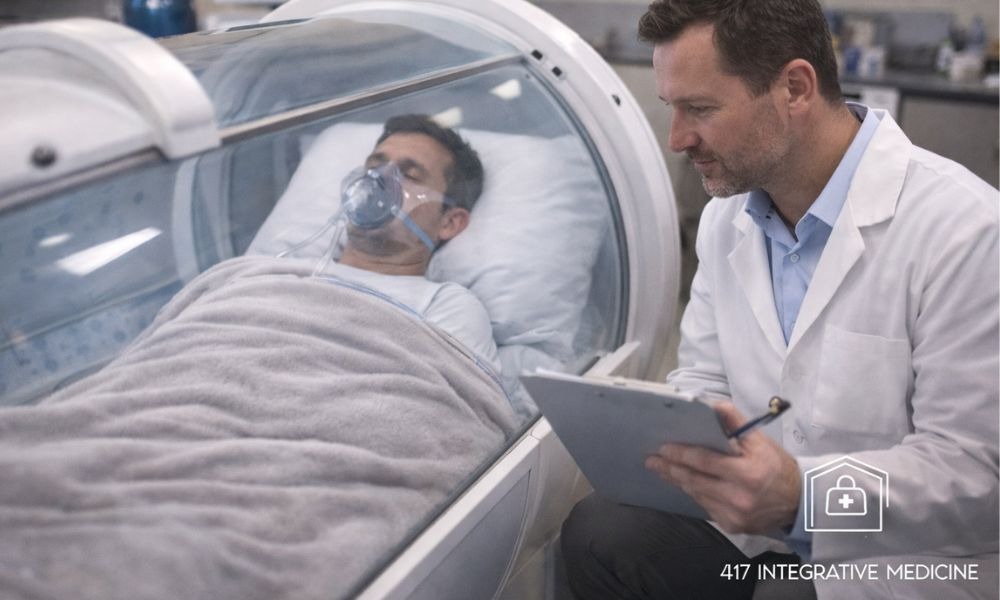
At 417 Integrative Medicine, hyperbaric oxygen therapy is one component of a broader approach that addresses root causes rather than isolated symptoms. The clinic’s providers assess each patient individually, considering existing oxygen delivery capacity, circulation status, and the specific tissues involved before recommending a protocol. HBOT sessions are conducted in a controlled environment where pressure and oxygen concentration are precisely regulated, consistent with the 2.0 to 3.0 ATA range most extensively studied in the literature.
The clinic serves patients across Springfield, Missouri, and the surrounding tri-state region, including those traveling from Joplin and Bentonville, Arkansas, who are seeking integrative approaches to recovery that address the biological mechanisms underlying their condition rather than managing surface-level symptoms.
What the Research Has Not Yet Resolved
Honest engagement with the HBOT literature requires acknowledging that some mechanisms remain under investigation. The Lindenmann et al. survey noted that how HBOT affects single effector proteins can produce either upregulation or downregulation depending on baseline cellular state. Session length, number of sessions, and pressure protocols are also not universally standardized. Most published clinical data uses 2.0 ATA as a reference point, but mild hyperbaric chambers operating between 1.0 and 1.5 ATA produce lower paO2 and correspondingly smaller activation of the repair pathways described above.
Translating documented mechanisms into a protocol that fits a specific patient’s biology, timeline, and goals requires clinical judgment that no generalized schedule can replace.
The Core Biological Argument
Hyperbaric oxygen therapy supports tissue recovery by operating on the same molecular machinery that healthy tissue uses to repair itself, at oxygen concentrations that injury, age, or compromised circulation cannot achieve through normal respiration. The documented effects span Nrf2 activation, NFkB suppression, VEGF-driven angiogenesis, MMP downregulation, stem cell mobilization, mitochondrial biogenesis, and epigenetic modulation of protein-coding genes. Each molecule named has a known function in repair. Each pathway described has a documented response to elevated oxygen tension. That specificity is what separates HBOT from general wellness claims and places it within the category of interventions that act on measurable biological targets with reproducible outcomes.